Last week I attended a conference in Uppsala. It was organised by
Devnet which is a network for researchers and students in sustainable development. It is financed by
Sida and based on
Uppsala University and
Swedish University of Agricultural Science.
Devnet was created in 2008. Last year
(2009) I was there with a lot of my fellow master students. We were invited since our lecturer was one of the key note speakers. When I got an invitation this year, I decided to go with a friend of mine since
the programme seemed to be promising.
If I compare the conference of this year to the one
last year, you could see that it has grown. More people, better planned and organised. Students and researchers had come specially just to attend those two days here in Uppsala. There were people from Italy, Spain, Costa Rica, Brazil, France, India, US, Vietnam, South Africa and many more.
I had decided to attend the second and the sixth parallel session. The first one was during Thursday and was named "community-based and community-driven natural resource management - a tool for poverty reduction and sustainable development". This one I picked to go to since I was curious to know more about it. I think my
master programme has focused more on rural development than on the natural resource management, so I figured it might be a good chance to get deeper understanding of concrete examples. This session had a high attendance. Unfortunately had one of the speakers been cancelled. But there was still three other ones.
One of them talked about the management of irrigation in Vietnam, and how to decentralise it from government level to the locals.
Another one discussed the community based organisation of forest management. This lecturer brought in Agrawal a lot, which was an author that we used much in one of our master courses. Many students felt
his book was a bit hard to grasp, and that especially that course could have become more educative by bringing in more than one main course literature. Even though I through that course got to know about
Elinor Ostrom.
(Swedish articles in online news about her, click here and here.)
Here is another way to depict the tragedy of the commons....
--------------------------------------------------------------
There was also a researcher talking about his study of small-scale fisheries. I enjoyed to see his illustrative networks of how the fishermen was relating to each others. But many of the audience was asking questions like; how did your research influence the society that you studied? Did you go back afterwards? But if they themselves did not perceive any problems of how they lived, what influence did your study do then? Perhaps it would have been better if you would not have done it? Why did you do your research?
I find this questions of importance of relevance. Not to say the least that perhaps we want to help, but to we do the research to get an examination or a report done or do we do it because we sincerely would like to make a difference? Do we do it because we want to enforce our own perspectives which we believe is the superior one, or do we do it because of learning of others? I have been told that we can never escape ourselves, being objective, we are in some ways always biased and we need to be aware of this. Although I feel very humble and that I still have so much left to learn. I hope I will continue feel like this when I start going to the field.
------------------------------------------------------------------------------------------------
The second day I went on a parallel session called "Cities, marginalisation, rights and citizenships". Many of the speakers were human geographers just like me, but there were also some anthropologists among us. I enjoyed to hear talks about the importance of having your own land and area to live in. We heard about female waste scavengers in Brazil, private land owners in Niger who started their own peri-urban societies by dividing the land. Furthermore, we could listen to different ways of aiding civil society by certain policies...
Even if this session did not had so many people in the audience, I think it was the most interesting and vibrant discussion of all the sessions that I went to. It was nice to hear about settlements and urban space, I miss to study that. I believe rural and urban is so connected, and within my master programme it is so focused on the countryside. Which is interesting of course, but I still lack the discussion of the city dwellers. We talk more about the outskirts of the city and the marginalisation of the people in shanty towns. So it was delightful to meet a lot of human geographers on this conference and hear them talk.
-------------------------------------------------------------------------------------------------------
To round up this post I would like to talk a bit about the
key note speakers. We had one that discussed about the importance to knowledge the climate change, this lecturer did unfortunately not generate so much of my interest. Perhaps it was since it felt like a topic spoken of so much, and that he did not need to defend it since among those that I speak with it is more or less a general statement.
For those of my readers that understand Swedish, it was a
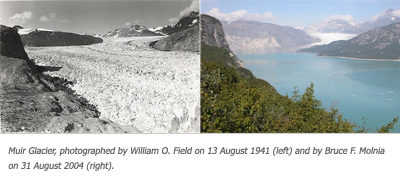
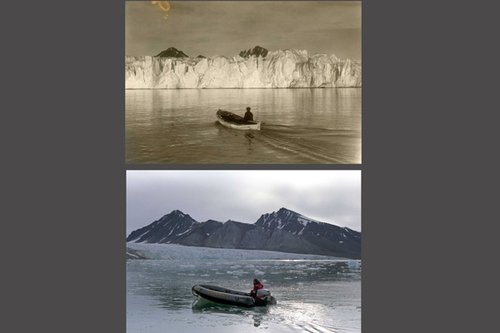
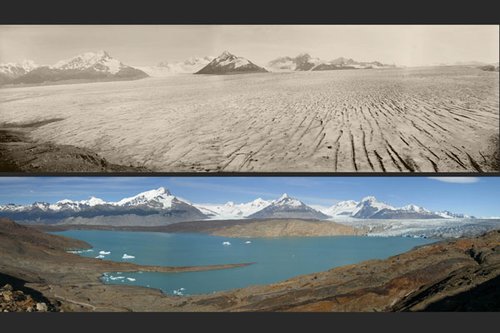
great article about this a few days ago. It brought up the importance of changing mentality as a way of not apathetic ignoring it, and why some of us perhaps have started to shut our eyes of climate change. By discussing with psychologists, the article stated that people do not pay attention so much because of (among other) following thoughts "it does not happen here" and "we can't see it" since it is happening sucessively so we adapt to the small changes and get blind of the bigger picture. For instance photos and elderly peoples accounts are great to illustrative this. Here is some photos of ice melting and change of glaciers...
Glacier in Patagonia Argentina, top 1928 and bottom 2004. More photos here.